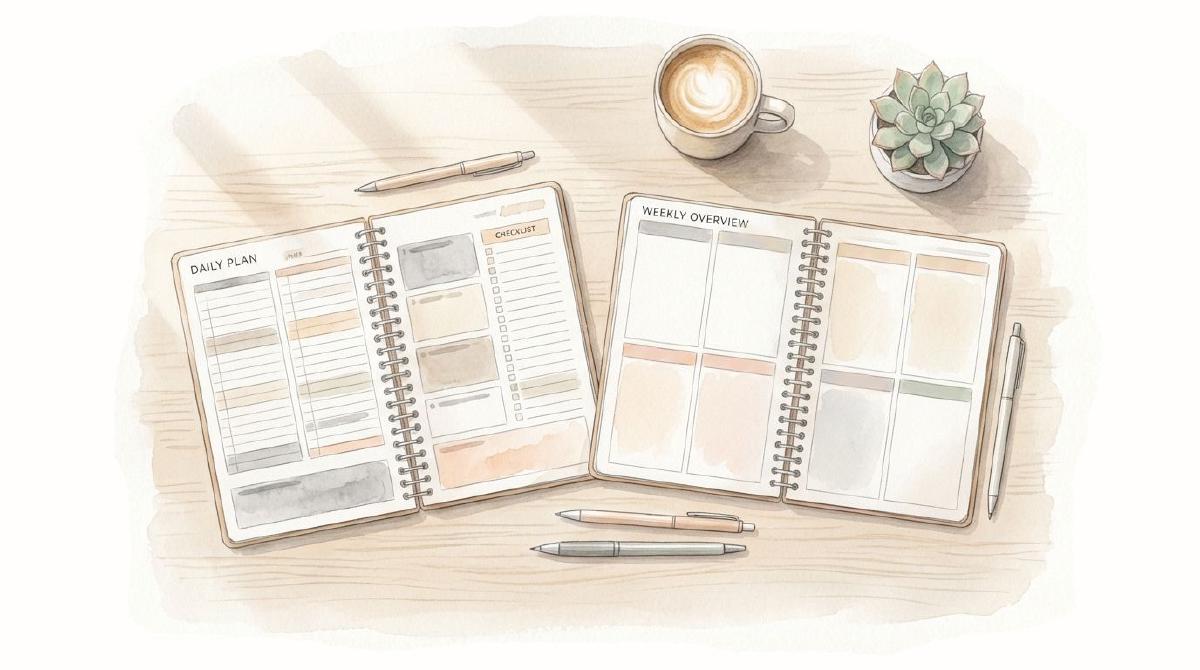
Some days, you finish your tasks feeling accomplished. Other days, you’re super exhausted. And no, it’s not because you didn’t work hard, but because everything just felt scattered. Tasks overlapped, priorities blurred, and time slipped away faster than expected.
But guess what? That’s rarely a motivation problem. It’s usually an issue with planning. And the debate between daily planner vs weekly planner isn’t about which one’s “the best.” In fact, it’s all about which one fits how your brain works and how busy your days are.
So, the big question that arises is, “Should you plan your entire week at once, or should a simple day-by-day mapping work?” After all, each approach has its perks, and choosing the right planner can make your days feel clearer, calmer, and more intentional.
Let’s find out which one would work best for you, depending on your needs!
Daily vs Weekly Planner: A Quick Comparison Table #
Before we look into the detailed comparison of both planners, let’s have a simple side-by-side overview to clarify how they differ.
Here’s a quick table to understand the primary differences:
| Feature | Daily Planner | Weekly Planner |
|---|---|---|
| Planning Focus | One day at a time | Full week overview |
| Detail Level | Very detailed | High-Level |
| Flexibility | Lower to moderate | Very high flexibility |
| Mental Clarity | Strong daily focus | Strong big-picture clarity |
| Routines & Habits | Daily trackers and prompts | Lacks space for daily tracking |
| Project Management | Only show one day at a time | Shows all tracks and deadlines at once |
| Note-Taking | May also include insignificant/minor details | Involves a valuable listing of the key events/tasks of each day |
| Ideal For | Busy, task-heavy days | Goal-focused planning |
7 Key Differences Between a Daily vs Weekly Planner That Matter #
Difference 1: Planning Scope #
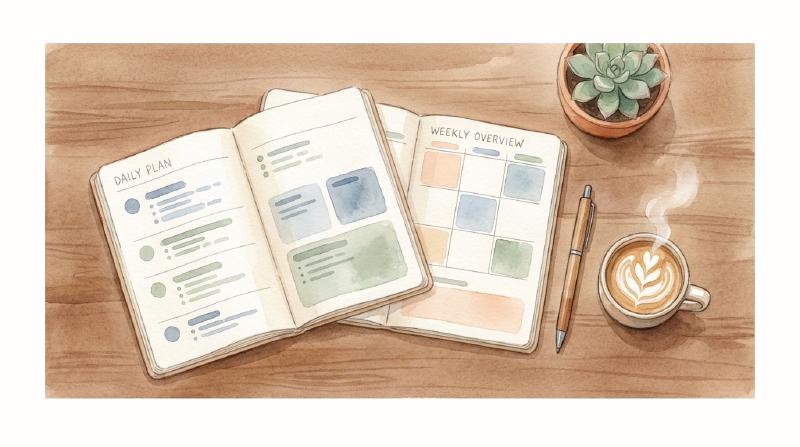
A daily planner operates on a small or micro level. What it does is narrow down your attention to what needs to be done exactly today, sometimes even hour by hour. That’s why it’s helpful for many people whose days are dense with meetings or deadlines.
In contrast, the weekly planner zooms out in terms of tasks. It mainly encourages you to think in chunks of days instead of separate moments.
So, instead of asking:
- “What do I need to do instantly?”
It asks:
- “How should my week flow overall?”
If you’re overwhelmed by too many minor tasks, daily planning can do the magic, as it gives you clarity and relief. However, if competing priorities and long-term pressure are your concern, choosing weekly planning is wiser.
Difference 2: Mental Load and Decision Fatigue #
Another aspect of planning that people overlook is how it affects their mental energy. The best daily planner with budget reduces mental pressure by externalizing decisions.
Once your day is properly planned, you don’t need to constantly see what to do next and follow up on the plan. This is more practical, as cognitive psychology research reveals that decision fatigue builds up throughout the day.
“The more choices you have to make, the worse your decisions become.”
Daily planners are helpful when it comes to:
- Decreasing “What should I do now?” scenarios
- Eliminating task-switching constantly
- Creating a clear-cut task execution path
While daily planners are quite beneficial, they also increase decision fatigue in case you need to replan every day without context. And that’s where Weekly Planner approaches come in handy!
Such planners help by:
- Letting you prioritize tasks once rather than daily
- Reducing work anxiety about the upcoming days
- Making space for mental breathing
Difference 3: Flexibility And Structure #
A daily planner focuses on structure. When the plan is all set, variations can feel exhaustive and disruptive. Let’s say if you get urgent tasks, unexpected meetings, or delays, you will need to rewrite the whole day again.
This rigidity can be really:
- Suitable for disciplined personalities
- Stressful for unpredictable/sudden schedules
On the other hand, the best weekly planner is more forgiving. If something doesn’t get done today, you can shift it to another day without any mental stress. This makes the weekly planner best for creatives, freelancers, or people with different workloads.
In a nutshell:
- Weekly planners facilitate adaptation.
- Daily planners demand strict commitment.
Difference 4: Goal Alignment and Long-Term Vision #
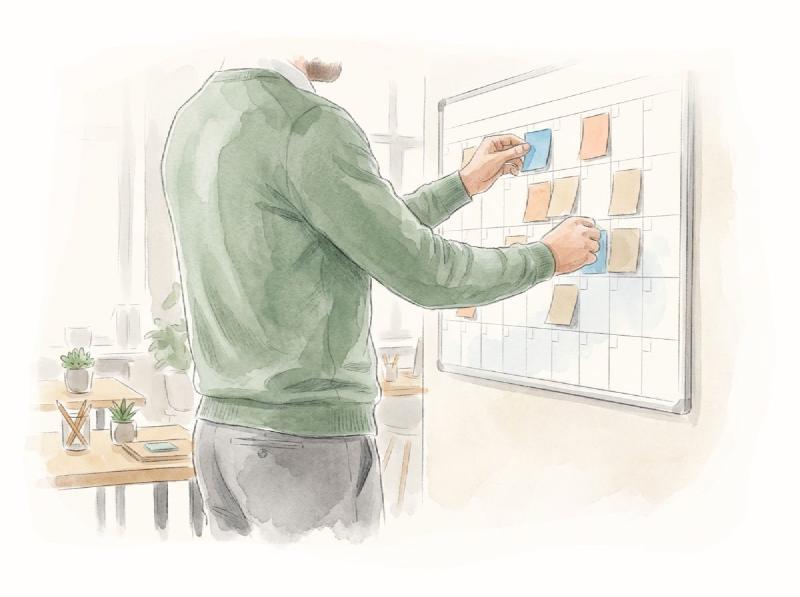
Planning goes beyond tasks and extends to direction.
A weekly planner promotes goal alignment naturally. Because when you see different days at once, it’s more convenient to connect regular actions to bigger goals.
In this case, it’s likely for you to ask:
- “Does this specific task move me forward?”
- “What actually deserves more time this week?”
Using a daily planner, on the other hand, can trap users in execution mode sometimes. That being said, you may finish several tasks without feeling any progress towards broader objectives.
Anyhow, that doesn’t indicate that daily planners aren’t good. Instead, it shows that they need internal reflection. While weekly planners are strategic, daily planners emphasize action.
Difference 5: Time Awareness & Realistic Scheduling #
When you opt for a daily planner, it forces you to confront time in a realistic manner. For instance, when you see just 24 hours in front of you, it becomes challenging to overload your schedule without implications.
This makes daily planners especially useful for:
- Busy bees who have strictly packed schedules
- Individuals who tend to neglect task durations
- Anyone working with tight deadlines
In terms of weekly planners, time perception can get distorted sometimes. After all, seeing the whole week at once may make tasks feel comparatively smaller than they are.
As a result, it can lead to:
- Overcommitments
- Feeling rushed by Friday
- Pushing tough tasks to later in the week
Because of this, weekly planners are often the best for spotting the time imbalances, like the fact that all of the meetings are crammed into two days.
Difference 6: Emotional Impact and Stress Levels #

Planning also affects how you feel. A daily planner can highly reduce your anxiety levels, as it narrows down the focus. But at the same time, it can also cause pressure if you don’t finish everything on time.
A weekly planner distributes the emotional burden across multiple days. That means it gives you enough room to make possible adjustments, so having a single unproductive day doesn’t feel awful.
This makes weekly planners a great option for people who are perfectionists, struggle with all-or-nothing thinking, or experience burnout.
Difference 7: Accountability and Sense of Achievement #
Depending on which planner you use, completion feels quite different. When you’re into daily planners, it gives you instant gratification. Crossing off tasks also creates a sense of control, and this acts as a psychological reward to give you more motivation.
In simple terms, daily planners excel at:
- Building more consistency
- Establishing productive habits
- Increasing confidence with progress
In contrast, a weekly planner comes with a different type of satisfaction. Rather than celebrating separate tasks, you think about how the week went and what you did.
This fosters self-awareness, pattern recognition, and improvement in the long run.
Suitability for Different Work Styles #
Your natural work style heavily influences which planner feels intuitive.
A daily planner works best for people who:
- Prefer clear instructions
- Thrive under structure
- Handle many small tasks daily
- Need strong focus to avoid distraction
A weekly planner suits people who:
- Think in systems rather than steps
- Work in bursts
- Juggle multiple projects
- Value autonomy
Using the wrong planner often feels like resistance — not because planning is hard, but because the format clashes with how you think.
Real-Life Scenarios to Help You Decide #

It’s sometimes easier to choose which planner would serve the best by considering real-life scenarios. For example, a daily vs weekly planner for students will have different requirements compared to the one for freelancers.
So, let’s dig into them:
| Lifestyle | Weekly Planner Wins When… | Daily Planner Wins When… |
|---|---|---|
| Parent | You plan grocery runs and family activities in weekly batches | You track meals, sports, and school drop-offs hour by hour |
| Student | You want help with assignment tracking across different courses | You need enough room for study time, and lecture notes every day |
| Creative Freelancer | You wish to map out deadlines and balance client projects | You block particular hours for writing, photography, or design |
| Remote Worker | Your tasks are usually project-based and can extend over several days | You’re fighting distractions and need to stick to a strict time schedule |
Bottom Line #
All in all, effective planning can be a real game-changer. But unfortunately, about 82% of people still lack a formal time-management system, according to a survey. So, it’s no surprise that they commonly deal with forgotten tasks or overwhelming situations.
And if you don’t want to be one of them, choosing a planner can be your best bet. Your choice about which one to choose between a daily vs weekly planner may vary as per your needs, but you can even combine them both.
Both of these can help you organize your life, but make sure you choose the right one, considering all the comparison details we mentioned above.
Good luck with your planner!
FAQs #
Q1. Is a weekly or daily planner better? #
The choice between a weekly or daily planner boils down to planning style and personal preference. People who depend on detail and structure may like a daily planner, while those who want to see a bigger picture and want flexibility can choose a weekly planner.
Q2. Can I switch between daily and weekly mid-year? #
Yes, definitely! Planning is not a commitment for life. A lot of people begin on a weekly basis and then switch to a daily planning routine during busy seasons, like product launches or exams. You can even combine the daily and weekly planner for more productivity.
Q3. Which planner layout is best? #
If you have a really busy schedule with tasks and appointments throughout the day, the daily or hourly layout can be the best solution. And for a more generic overview, the monthly or weekly layout could be perfect.
Q4. How do I structure my planner? #
If you want to structure your planner effectively, follow these quick steps:
- Do research and get the right planner for your needs.
- Add your deadlines, appointments, and events to it.
- Set up not only your weekly but also your monthly and yearly goals.
- Break down your bigger tasks and goals into small, actionable steps.
- Create weekly and daily tasks and well-organized to-do lists.
Q5. What is the most efficient way to use a planner? #
To use your planner efficiently, make sure you make it a crucial part of your daily routine. Spare time every day to review all your tasks and also plan for the upcoming day. Plus, you can set alarms and reminders on the phone to keep checking on the planner regularly.