
A screen is probably the last thing you see before you turn off the light to sleep and the first thing you look at whenever you wake up. You may sit in front of your phone for pleasure and to interact with others without being present physically.
As a busy entrepreneur, I absolutely know the struggle: every alert, ping, and scroll trains us to stay “always on.” In fact, a 2023 Pew survey revealed that 95% of U.S. adults go online regularly and 90% own a smartphone.
And it’s not that people come online constantly with an intention. You just turn on the phone to check a work-related notification, only to end up finding that you wasted so much time by mindless scrolling. Frustrating, I know!
That’s why a weekly digital detox of one day (or even a few hours) can be super helpful. It’s like you’re hitting a RESET BUTTON in your mind and gaining back your focus, time, and sanity on the go.
Eager to explore more? Keep scrolling!
What Is a Digital Detox & How Does It Work? #
In short, a digital detox means intentionally deciding to reduce, or even refrain from, using electronic devices for a specific period.
The old approach to detox was to take time away from screens completely, whether they’re from laptops, mobiles, or TVs. But it’s no longer feasible in the digital world we live in.
The best way to do a free digital detox for busy people is:
- Reducing unnecessary screen time instead of eliminating it
- Limiting social media or news consumption
- Turning off non-essential notifications
- Setting specific times for checking emails or apps
- Prioritizing offline activities like reading, journaling, or resting
Signs You Need to Digital Detox & Unplug Now #
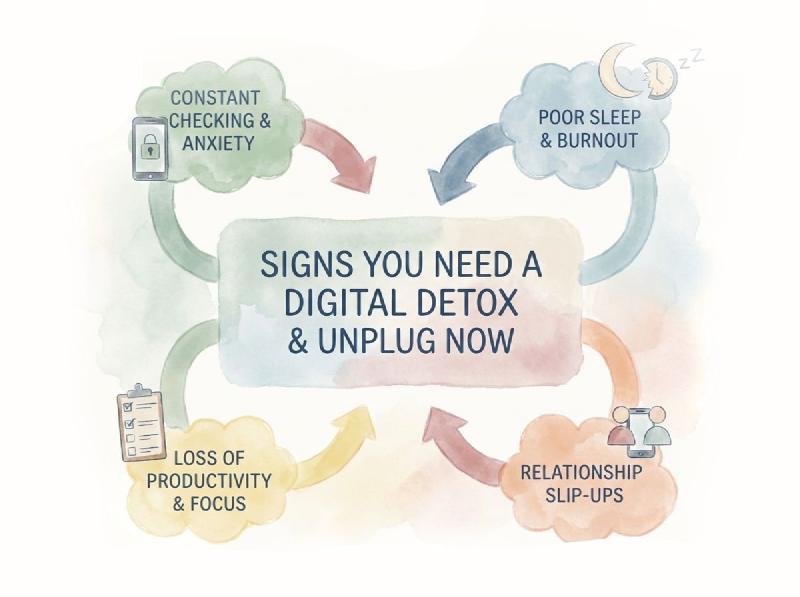
A phone or digital detox is needed the most if you realize that your digital life is taking you away from reality. Whether that be texting while sitting in a group or being distracted amidst conversations whenever a notification pops up.
Below are some more red flags that can help you identify that your digital life is tipping into overload:
- Constant Checking & Anxiety: Do you reach for your mobile the moment you wake up or when you’re idle? Shockingly, feeling anxious if your phone is in another room is pretty common. And this “nomophobia” (fear of being without a phone) can often lead to stress when we’re offline.
- Poor Burnout and Sleep: Does your mind race immediately at bedtime if you scroll through work email or social media? Note that the mental stimulation and blue light from evening screen time can disturb sleep patterns. So, if you also wake up tired from late-night tech use, it’s time for a tech curfew.
- Loss of Productivity & Focus: Are your to-do lists always getting longer, but you never get a chance to finish them? Well, being interrupted by alerts or habitually multitasking on devices can distort your attention and result in reduced productivity and disorganization.
- Relationship Slip-Ups: Do you often catch yourself entirely zoning out during conversations or skipping quality time? Especially if friend hangouts or family dinners look like you’re half-absentminded on your mobile, you’re seriously missing out on real connections. So detox your mind to engage more with your loved ones.
If you’re also going through any of the above signs, it’s time to stop there. Even if cutting off technology at once seems impossible, just start small (with regular breaks).
Because sometimes, “the best connection is disconnection.”
By now, you might be wondering how to plan and execute your weekly digital detox, right? Well, here’s exactly what you need to do:
8 Ways to Do a Digital Detox (Without Pulling the Plug Completely) #
Okay, so how do you actually stick to a digital detox? Especially when you remain super busy? The thing is, you need to treat your digital detox like an appointment and something you look forward to.
Here’s what to do for a weekly reset:
Tip 1: Pick Your Detox Day or Block #
If you work on your laptop all day, it gets pretty tough to avoid screens. Right?
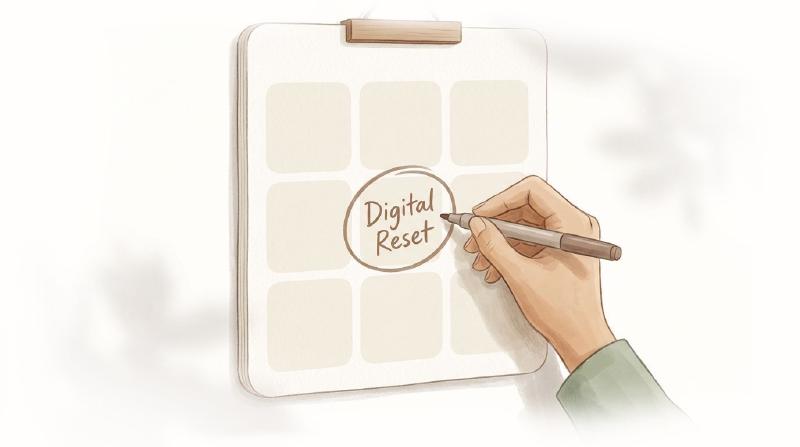
But that also means it becomes more important to pick a detox or block day by setting up a specific time in your calendar.
For many, one day on a weekend (let’s say Sunday) works great. Or else, you can even choose a weekday evening as per your convenience.
The timing is all up to you. Manage it whatsoever.
What really matters is how consistently you follow it.
And to make sure you don’t miss out on your scheduled time, circle it on the calendar or set an alarm for a gentle reminder: “It’s Detox Time.”
You can also specify what to do within that time limit, like eating lunch or going for a walk. But make sure you leave your mobile behind, whatever you do.
Tip 2: Start Small and Build Up #
Don’t panic… If you think you’ll have to unplug for the whole 24 hours from day 1, that’s not the case. That won’t even work!
Even when I started, my digital mess made me feel out of reach and like I was losing control over A LOT of things.
Expert organizers often share that progress shows up when you start small, and not if you try to fix everything all at once.
Think of a digital detox for students like “cleaning your home.”
- Start from one room or space.
- Slowly move to other rooms.
- Once ready, clean the whole house.
In simple terms?
- On “Detox Day 1,” don’t look at your phone for 10-15 minutes after lunch.
- And the next week, try to improve and go up to 30 minutes.
- Eventually, work up to a few hours without screens or a full day.
And guess what? If you do this, it won’t even feel like torture or a burden on your soul.
Tip 3: Set Realistic Boundaries #
In theory, filling the empty phone-time space sounds appealing. But in practice, it’s surely challenging, especially when your phone is already in your hand.
And when this happens, offline activities seem harder to even start.
So first, think about what you can actually do without. Maybe you still need mobile access for task priorities) or emergencies, and that’s OKAY.
Because the goal is to limit, not entirely eliminate, in the beginning. It’s not even possible, as your mind is used to a digital world.
But here’s what you can make a digital detox checklist for peace of mind:
- Announce to family or colleagues that you won’t be available from 5 to 6 p.m. so you can enjoy your dinner.
- Set clear on/off times to help your brain relax rather than thinking, “Did I miss something?”
Even if a realistic detox means you need to sit with a little discomfort for a while and let your attention wander, that’s better than any dramatic reset (and also likely to last).
Tip 4: Turn Off Notifications #
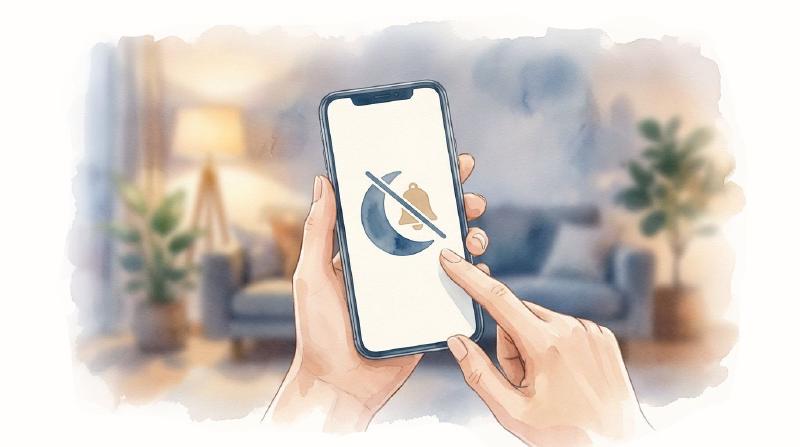
Another important step you shouldn’t miss out on is turning off notifications whenever possible. Because honestly, nothing hinders unplugging more than a lit-up screen.
So, before you start detoxing, switch off your phone or mute app notifications, text tones, and email pings.
Believe me, if you do this, nothing will whisper in your ear to say, “Hey, look at me.”
And consequently, it will let you focus on real life, and you won’t feel the urge to check your phone over and over again every two minutes.
Because in the end, it’s a matter of a few minutes, right?
And it won’t do any harm to enable “do-not-disturb” mode and silence calls or notifications after a day full of hustle and hectic mind work.
Tip 5: Replace Before You Remove/Plan Offline Activities #
Start your mornings screen-free. Make tea, journal, or stretch.
More so, you can pair offline activities with little rewards. For example, you can leave your phone at home when you go for a walk or a coffee/lunch break.
Yeah, it would probably feel awkward initially, like you are forgetting something important.
But things will be fine… trust me!
Now? Talk to your colleague or friend without half-listening. Just find your own version of this: a screen-free ritual that reconnects you to what truly matters.
In addition, it’s wise to keep a nice “real-world” list where you place things to do whenever you feel the urge to open social media or scroll.
Let’s say, write:
- List of hobbies you really enjoy
- Going for a quick run nearby
- Playing a board game
- Reading your favorite book
- Cooking a new recipe
- AND MORE!!
The benefit? When your detox time hits, you are not thumb-twiddling aimlessly but are ready to do something absolutely relaxing and fun instead.
Tip 6: Involve Others for Assistance #

Tell your partner or friends about your digital detox plan. Yes, that’s right. Maybe even invite them to do this practice too.
Why, though?
See, when you have an accountability partner on your side, it supports you in many ways.
For instance, you can declare, “Saturday evenings are phone-free dinner time,” and then simply ask your friend to remind you.
Furthermore, you can schedule a weekly movie night or a hike with friends with a strict “no-screen” rule.
Working alone looks hectic, no doubt. And when you make a group and do a commitment collectively, it becomes much easier.
Note: Consulting with a mental health professional can also assist if you feel that your feelings and behaviors are going way out of control and nothing seems to work. Never hesitate to seek help when needed :).
Tip 7: Allow Flexibility (White Space) #
Leaving some “me-time margin” in your detox schedule can never go wrong.
If your week throws a surprise meeting during your specific detox slot, keep enough room to reschedule your break without abandoning it.
After all, a healthy mindset should be:
- I will unplug each week, no matter what. I’ll adjust whenever needed.
Instead of:
- I can quit digital detox for now and may start fresh all over the next week.
This flexibility means you’re giving yourself a “white space grace.”
It always works because it prevents you from falling into the “all-or-nothing” trap, so you can never miss out on your sessions.
Tip 8: Expect the Withdrawal Wave #
Boredom and restlessness are pretty normal if you think about it.
Name it, “This is only a craving that will pass.” Step outside, move your body, or talk to a friend in person.
Believe me, this discomfort goes faster than you can imagine. You just have to be clear, and that’s it.
That’s why whenever a withdrawal wave hits you, remember that it’s only a trick and a fear.
Because you know what? Nothing collapses when you stop or pause. Accept it!
The world keeps running. And all that changes is “You” whenever you stop moving with it. Hence, when a voice whispers, “You’re going to miss out on something,” don’t listen.
Just answer, “I will hear myself all over again,” and quietly do the calm things you were doing.
Sample Weekly Digital Detox Schedule #
Not sure how to create a weekly reset plan to get the most digital detox benefits? I’ve made a sample weekly digital detox app schedule that you can adapt and use in your life.
Just pick whatever elements you feel fit your current life situation:
| Day | Detox Focus | Example Activity |
|---|---|---|
| Monday | Full Digital Sabbath | Spend the day device-free: go for a long hike, cook a new recipe, or read. |
| Tuesday | Evening Unplug | No screens after 8pm. Enjoy a phone-free dinner and a calming bedtime routine (e.g., a bath, reading). |
| Wednesday | Notification Detox | Turn off all non-essential notifications (email/social media). Use ‘focus mode’ during work. |
| Thursday | No-Phone Zone | Keep phones out of the bedroom. Replace the bedtime screen with meditation or journaling. |
| Friday | Social Media Limit | Limit social apps to 30 minutes total. Use a timer if needed, then switch to a relaxing hobby. |
| Saturday | Tech Check-In | Review your gadgets: delete unused apps, clear your email inbox. Prepare for a lighter digital weekend. |
| Sunday | Outdoot / Family Time | Plan an activity with friends or family without devices: a picnic, game night, or nature walk. |
Ready to Hit Reset? Start from Today! #

By now, you’ve seen that the best digital detox for busy people is all about reclaiming the life. After all, busy people also deserve a break from screens, just as much as they deserve healthy meals, good sleep, and laughter moments with friends. Because being “busy” should never be an excuse for burnout!
A 2021 study, in fact, revealed that students who finished a social media detox reported many positive changes to their sleep, anxiety, and mood. Another study concluded that women who quit Instagram reported higher life satisfaction than those who continued using social media.
That’s how big the impact of digital detox is! You don’t even need to start big. Every little effort counts. Even short breaks and mindful habits can help make your mind more peaceful and calm. Start by sparing yourself a single tech-free evening, and you’re good to go.
Just don’t let your screens drain you. Hit the “off” button on devices for a while, and turn “on” your mental peace!
Feature image by Marvin Meyer on Unsplash