Let me guess. You love the planner journaling ideas…
But when it comes to doing it in real life, things get messy real quick. One notebook turns into three.
A simple habit turns into a “huge system.” And suddenly, journaling feels like “another thing to keep up with” instead of something that helps you breathe.
Sounds familiar, right?
Well, here’s the thing: you’re not doing journaling wrong.
You’re just trying to do too much of it.
That’s where minimalist journaling steps in as a solution, especially for people who already use (or even wish to use) a weekly planner.
In this blog, we’re highlighting some simple yet realistic minimalist journaling ideas that actually stick. Let’s get straight into it!
Why Planner Users Are Perfect Candidates for Minimalist Journaling #
No one will say this loud, but the truth is:
- “Journaling never fails because people aren’t consistent.”
- “It fails because their journaling system is too complex.”
Simply put? Easy self-reflection habits are far more likely to work long-term, as they need less cognitive effort.
If you already use a weekly planner, you’ve got a huge advantage because they give you the structure, limit space, and encourage reflection in small doses.
What minimalist journaling actually does is layer reflection into what you’re doing already.
Instead of asking:
- “What should I write?”
You ask:
- “What really matters this week?”
A BJGP study found that habits attached to existing behaviors build more conveniently than standalone habits.
As your planner is already a habit, minimalist journaling moves in silently beside it.
The “Less but Better” Rule for Journaling in a Planner #
If your journaling makes your weekly planner harder to use, it’s too much.
After all, minimalist journaling isn’t about:
- Long diary entries
- Perfect handwriting
- Aesthetic spreads
But rather:
- A few focused lines
- Clear prompts
- Consistency over creativity
Many people consider it “micro-journaling,” which means it consists of a phrase, a sentence, or a short list. Not because you’re lazy, but because your life is full.
After all:
“You do not rise to the level of your goals. You fall to the level of your systems.” — James Clear (Atomic Habits)
And when journaling feels feasible, it certainly happens.
Simple Minimalist Bullet Journal Ideas That Work Inside a Weekly Planner #
Minimalist journaling works best when combined with a planner so naturally that it doesn’t feel like trying to adapt to a separate habit.
That’s why we compiled the minimalist journal ideas, built specifically for weekly layouts, so they fit into the space you already use.
Idea 1: The One-Line Daily Check-In #
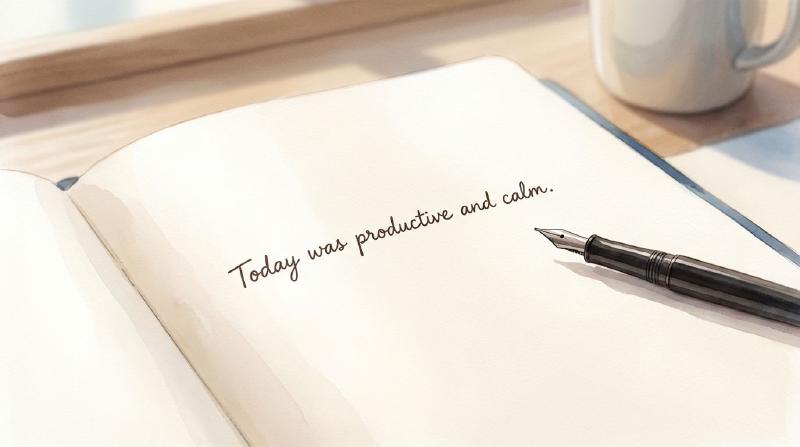
This is the easiest place to start to develop effective minimalist journaling habits.
All you need to do is write one sentence a day. That’s it.
Let’s say you write your feelings, a realization, or possibly a quick observation about the day.
Here are some instances to help you understand:
- “More tired than I expected.”
- “Heavy day, but still productive.”
- “Focused once I stopped multitasking.”
No depth at all. Just honesty in small doses.
Why does this work?
It is super helpful for many, as it removes the pressure to analyze or explain. That means you’re not solving anything but simply noticing.
And over time, these one-line entries begin to reveal your patterns.
You will notice that certain days always drain you or that your best focus happens under specific conditions. This awareness itself makes it even more powerful for long-term growth.
Idea 2: Weekly Intentions (Not Goals) #
Goals can be motivating, for sure. But when life doesn’t cooperate, the same goals feel rigid, heavy, and unforgiving.
Intentions are different, though.
At the beginning of each week, write 1-3 intentions that guide how you want to move through the coming week, not what you “must” accomplish.
Choose one day a week, set a short time limit (about 10-15 minutes), and write only what’s mentally noisy.
That way, you won’t be dumping everything when anxiety hits and life gets tough.
For example, you may just write “Protect my energy” or “Finish strong, not perfect.” And yes, just dump the unimportant stuff.
Circle what matters, and ignore the rest.
Because in the end, intentions don’t add more tasks to your planner. They mold your approach according to the tasks already present there.
Idea 3: The “What Worked/What Didn’t” Box #
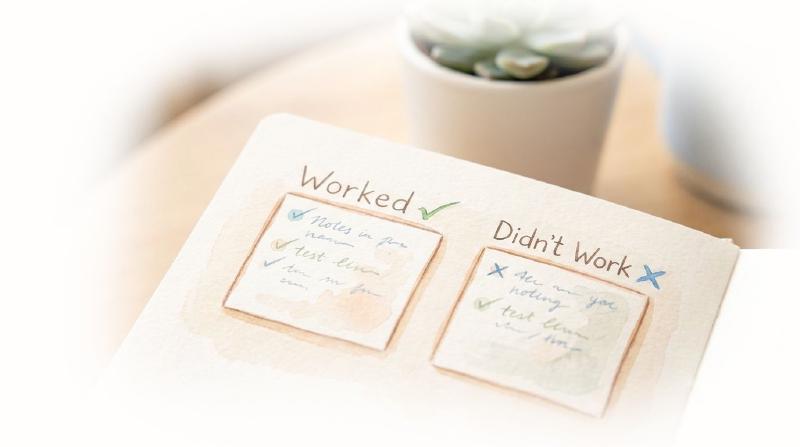
At the end of every week, answer three quick prompts while being honest with yourself:
- One thing that worked.
- One thing that didn’t.
- One thing to adjust.
Don’t write long stories or self-judge.
You’re not trying to improve all things at once, but writing what worked and what didn’t for a gentle reminder. That’s where real perception comes from.
Believe me, this quick reflection is going to improve your performance and learning a lot.
After some time, this quick practice will turn your planner into a feedback loop. You stop repeating what doesn’t work and begin focusing on what does (naturally, without forcing change)
Idea 4: The Energy Check (Not a Mood Tracker) #
Rather than tracking how you felt, track how you felt afterwards.
Once or twice a week, write down, “What gave you energy, and what drained you?”
Mood awareness is one of the key factors in emotional regulation, too. So, this activity is especially essential to connect your energy directly to your schedule.
The cherry on top is that you don’t even need a rainbow tracker for this. Minimalist mood tracking can be as simple as:
- One word per day
- A symbol (↑ ↓ →)
- A number from 1 to 5
When you complete your tracking, you will notice patterns like specific meetings leaving you exhausted, overpacked days draining you, or certain tasks taking more energy.
And no, the goal is not to judge your week. It’s to fully understand it.
That being said, you’re automatically going to gather information that can help you plan your future weeks with more intention.
Idea 5: The “Let This Go” Line #
Try to dedicate a little space in your planner for things you’re consciously releasing—putting a burden off your chest.
It could be:
- A mistake you keep replaying
- A pressure you don’t need to carry forward
- An expectation that didn’t serve you well
Examples:
- “Letting go of needing every day to be productive.”
- “Letting go of rushing through the week.”
Yes, just let them go. No explanations or fixations needed.
And this act of closure shouldn’t even give you any guilt, as this isn’t toxic positivity but something that helps create emotional boundaries inside your planner.
With this quick task, old thoughts don’t spill into your next week. Most importantly, you have enough clarity and mental space.
Minimalist Prompts You Can Rotate (So You Don’t Get Bored) #
The best part is that you don’t need new prompts every day. Just a small set you trust would do.
Let’s look at a few minimalist prompts that work wonderfully in planners:
- “This week taught me ___.”
- “Something I’m proud of: ___.”
- “Right now, I need more ___ and less ___.”
- “Current battery level: [ % ] because ___.”
- “One thing I want to remember from today: ___.”
- “One thing I checked off that wasn’t on the list: ___.”
- “If I could only do one thing tomorrow, it would be ___.”
A Simple Weekly Planner + Journaling Setup (Example) #
Being a planner user, do you want a realistic, simple diary ideas design as an example? Here’s something you’ll find sustainable in the long run:
| Section | The Goal | The Prompt / Action |
|---|---|---|
| Weekly Priorities | Set the tone | Write one “Core Intention” (e.g. “Work on a project”) |
| Daily Boxes | Rapid logging | List 3 tasks + one “Daily Highlight” |
| Notes Section | Weekly review | “What worked / What didn’t” - Keep it to two bullets each |
| Margin Space | Inspiration | A single “Power Quote” or a mantra to glance at during stress |
| Journaling Slot | Reflection | Use one of your “Rotating Prompts” at the very bottom |
Common Mistake: Trying to Journal Like Someone Else #
A big mistake people make while journaling is “trying to be like someone else and expecting things to work.”
You see someone’s journal ideas online with highly curated pages, nicely worded reflections, and a beautifully structured system that looks super inspiring.
And then, you try to copy it. Same layout. Same prompts and routine.
Yeah, it seems motivating at first.
But does that work for long? Absolutely not.
With time, you will notice that your days don’t look like theirs. And of course, your brain won’t process things the same way either.
What energizes them may entirely drain you. And then, journaling will all feel forced!
That’s why you should write your journal your own way.
- Do bullets work for you? Use them.
- One sentence feels enough? Stop there.
Even if the journal feels practical one week and emotional the next, that’s OKAY.
The moment you stop comparing your minimalist planner ideas to someone else’s and begin to let it capture your life, it becomes lighter and easier.
How to Make Minimalist Journaling Stick (Long-Term, Without Burning Out) #
Starting is one thing; staying consistent is another. And that’s where people struggle.
Because honestly, even minimalist systems can be exhausting at some point if you overmanage them. So, let your journaling and simple planner ideas evolve with time rather than lock them into rules.
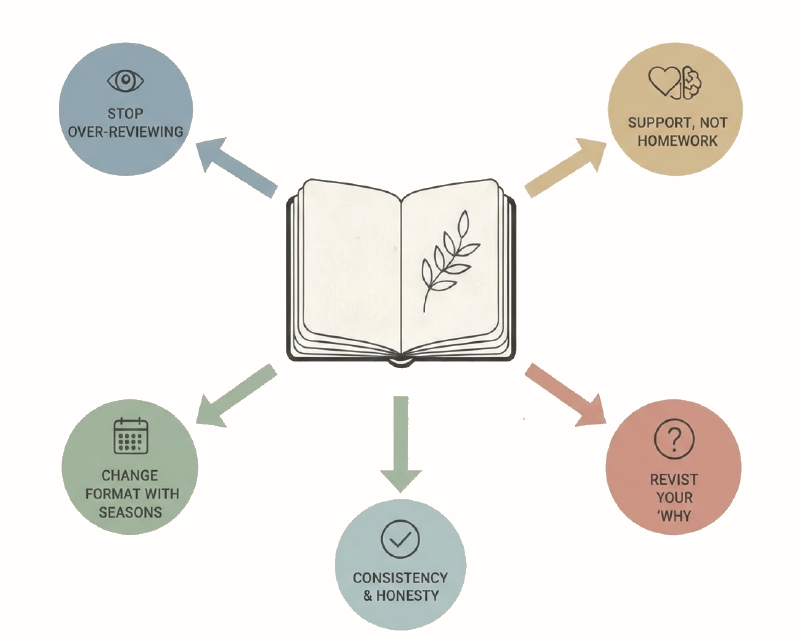
Here’s how you can protect your long-term minimalist journaling habit:
- Stop Reviewing Too Often: Don’t over-review your journal, or it can turn into self-surveillance. Skim occasionally, notice the patterns quickly, and then move on.
- Use Journaling as Support, Not Self-Improvement Homework: If your journal makes you constantly “fix” yourself, you’ll avoid it, so let it be a neutral space without judgment.
- Change the Format With Life Seasons: What worked during a calm month may not go well during a stressful one. Hence, adjust your minimalist journal accordingly.
- Revisit Your “Why” Occasionally: Are you journaling for clarity? Better decision-making? Emotional processing? When you remember why you started, you’ll not abandon it when it gets boring.
See, minimalist journaling always lasts because it doesn’t demand performance. All you need is consistency and honesty!
Final Words #
In a nutshell, journaling ideas are not about doing less for the sake of it. They are more about doing exactly “what matters” and letting go of the rest (the unimportant!).
Especially when journaling fits into your daily or weekly planner, it becomes more useful and consistent, which is the real win.
Good luck with your journaling, folks!