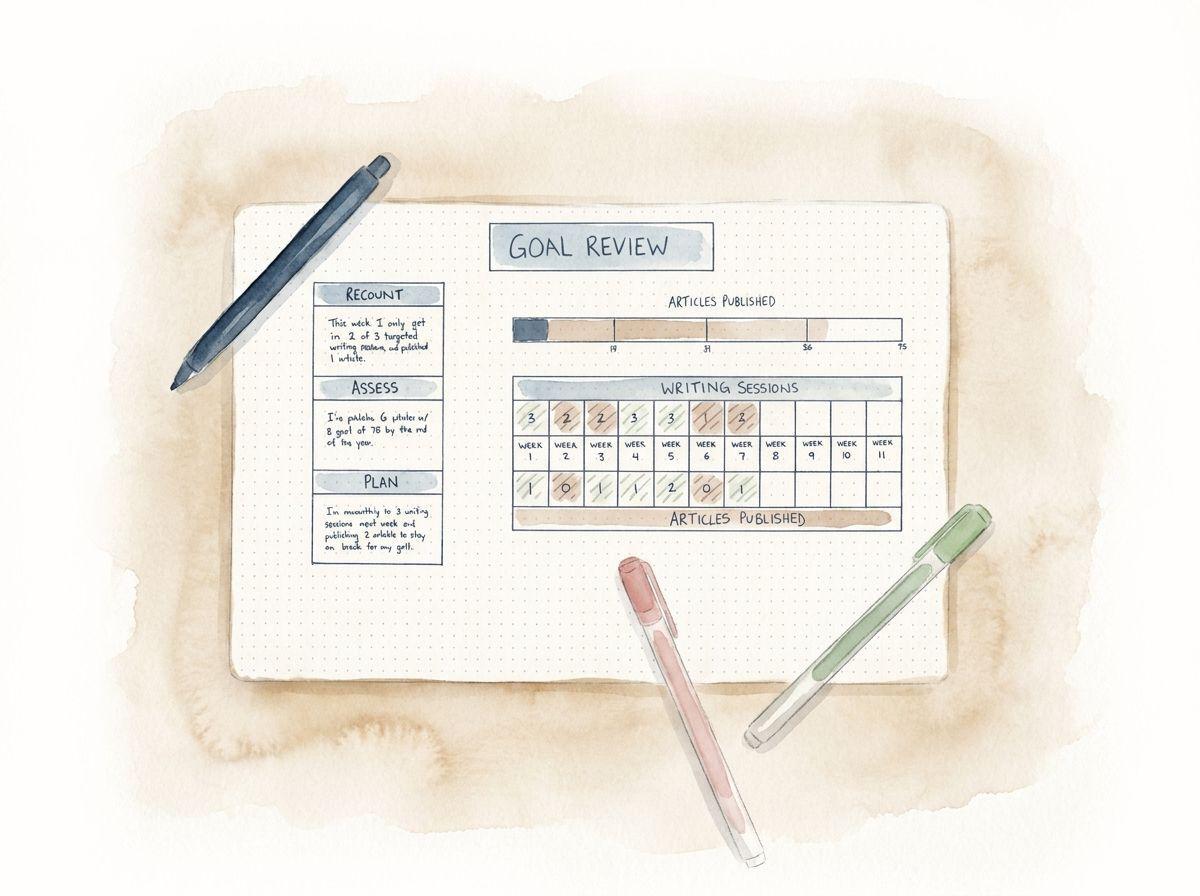
Okay, so here’s the thing. You’ve probably heard the claim that people who write down their goals are 43% more likely to achieve them. It’s one of those productivity statistics that gets repeated so often that we rarely stop to ask what the original research actually found.
A number that specific must be true, right? Well, maybe. The real story is a little more complicated. So naturally, we’ve started treating writing goals as if they were the entire secret. The whole enchilada.
Grab a fancy journal, write “I will run a marathon” in your best cursive, close the journal, and boom … you’re basically crossing the finish line.. RIGHT?!
Want to know more about it? Keep scrolling!
Writing Your Goals Is Just the First Step#

Listen, I used to believe this too.
I have dozens of record books filled with goals so beautifully written that art museums should probably be calling me.
Perfect bullet points, gorgeous handwriting, even color coded by category: health, money, and vague spiritual growth.
And you know what all that gorgeous penmanship got me? A drawer full of notebooks and a mild sense of guilt every time I opened it to look for a pen.
But since we’re apparently supposed to treat “write it down” as the finish line instead of the starting point, let’s look at five ridiculous reasons why that supposedly should be enough.
5 Reasons Writing Down Your Tasks Isn’t Sufficient#
At this point, you might be wondering what it really takes to get things done and why simply recording your goal doesn’t cut it. So, let’s roll up our sleeves and find out what actually moves the needle!
1. Writing the Goal Does All the Work for You#
This is definitely science. Probably.
When you write “lose 15 pounds” on a sticky note, the ink apparently travels through your fingertips and straight into your DNA, where it permanently programs you to make better decisions.
From that moment forward, your body simply knows what to do.
- No further action required
- No gym needed
- No healthier meals required
- No need to question those late-night snacks
Certainly no need to actually change your habits. The sticky note has already done all the heavy lifting for you. Literally. Pretty impressive for a tiny piece of paper.
2. Once It’s Written, the Universe Will Make It Happen#
Apparently, there’s a cosmic paperwork department where writing “start my own business” sends the universe a notification and gets everything moving behind the scenes.
- Investors start Googling you.
- Customers start missing a business that doesn’t exist yet.
- Opportunities magically begin lining up.
It’s basically manifestation, except we’re skipping the annoying part where you’re expected to actually do something. And we’re skipping that part today because taking action sounds like a lot of effort and we’ve already done the hard part: buying a nice pen.
This is where most people drop the ball.
They write down a big goal, close the notepad, and call it a day. Yes, there’s nothing wrong with creating a written target. Writing them down can make them feel more real and give you a clear direction.
But what if you treated that goal as a starting point and turned those nice words on the page into something you can actually work toward?
That would be a game changer.
Once you put a goal on paper, use these three steps to turn it into something actionable:
- Be specific: Instead of “start a business,” identify the type of business, who it will serve, and what you want to accomplish first.
- Break it down: Turn the big goal into smaller tasks you can actually complete.
- Take action: Decide on the next step and put it on your schedule.
For example, instead of simply writing:
“Start my own business.”
Try:
- “Research three business ideas this week, choose one by Friday, and outline the first three steps.”
Now your diary isn’t just holding a dream. It’s holding a plan.
The best part? You still get to use the nice pen. But this time, it’s actually doing some work.
3. Writing the Goal Counts as “Progress,” Apparently#

Think about it. You wrote “write a novel” on your goals list. That sentence has the word “write” in it TWICE if you count the goal itself. That’s basically two chapters, if we’re being generous with our accounting, which we absolutely are today.
At this rate, you’ll have a finished manuscript without touching your laptop again.
- Two “writes” on the page
- One beautifully worded goal
- Zero actual writing required
It’s a snowball. A very small, completely stationary snowball sitting in a notebook and going absolutely nowhere.
And honestly, that’s progress.
At least that’s what we’re telling ourselves.
4. Once You Write It Down, You Never Have to Look at It Again#
Some people say you should look at your written goals regularly. Weekly, even! Can you imagine? Actually opening the planner more than once?
That sounds suspiciously like work.
And also like admitting the first time wasn’t enough, which — okay, fine, it wasn’t, but we’re not talking about that.
Apparently, you’re supposed to review them:
- Revisit what you wanted.
- Check whether you’re making progress.
- Adjust your next steps when necessary.
You know, actually use the goal.
We already established the ink situation. Apparently, it can handle everything without us.
5. Planning Your Week Is Someone Else’s Problem#
Once you’ve written down your goal, the next step is to give it a place in your actual week. When you sit down to plan, ask yourself:
- “What does a successful week actually look like?”
Don’t just write every task you could possibly do. Focus on the outcomes that would make you feel like you actually moved the needle.
Start by choosing the three most important priorities for the day, then build the smaller tasks around them.
- Pick the tasks that matter most.
- Let smaller tasks fill the gaps.
- If something doesn’t fit today, push it to another day instead of cramming your schedule.
That’s the difference between simply making a plan and creating one you can realistically follow.
You’re giving yourself enough structure to know where you’re going without packing every minute so tightly that there’s no room to breathe.
The Truth About Writing Down Your Goals#

The process looked more like this:
| Step | What Actually Happens |
|---|---|
| 1. Write the goal | Get specific about what you actually want to accomplish. |
| 2. Create action commitments | Decide what you’re going to do to move toward that goal. |
| 3. Put the plan into motion | Turn those commitments into real actions instead of leaving them on paper. |
| 4. Track your progress | Keep yourself accountable for whether you’re actually moving forward. |
| 5. Report your progress | Share weekly updates with a friend who can help keep you accountable. |
The Part Nobody Puts on the Motivational Poster#
The study wasn’t simply comparing people who wrote “get fit” on a napkin with people who did nothing.
Participants were placed in different goal-setting conditions, including groups that wrote down goals, created action commitments, shared goals, and reported progress.
In other words, writing was only one part of the larger process.
Somewhere along the way, the more complicated message got shortened to “write your targets,” because that version fits neatly on a motivational poster.
Writing the goal matters.
But what happens after you put the pen down matters even more.
Conclusion#
Writing the targets isn’t a magic trick or shortcut to success. It’s a simple way to turn a vague wish into something specific enough to act on.
The real progress happens after the notebook closes. Choose the next action, put it on your calendar, review your progress, and keep showing up.
So write the goal down. Then go do the thing the notebook can’t do for you.
For practical tools and planning strategies to help turn your goals into action, visit Weekly-Planner.com.
FAQs#
Q1. Does nicer handwriting make my goal more likely to happen?#
No. The ink doesn’t know cursive from chicken scratch — it only responds to what you actually do after you close the notebook.
Q2. If I write it down and never look at it again, is that basically the same as achieving it?#
Nope. That’s just a goal collecting dust in a drawer. Reviewing it is how you actually know if you’re moving.
Q3. Does telling a friend really help, or is that just accountability theater?#
It genuinely helps. People who send weekly updates to a friend report much higher success rates than people who go it alone.
Q4. Should I keep my goal big and vague, or make it specific?#
Specific, always. “Start a business” has no next step hiding in it. “Research three ideas by Friday” does.
Q5. So is writing goals down pointless?#
Not at all. It’s the on-ramp, not the destination. Write it down, then go do the part the notebook can’t.