
Most people want to reflect more. They simply want to assess themselves, track all their growth, and figure out what’s working and what isn’t.
But somewhere between the “I should begin journaling” thought and really sitting down to do it, life happens. And that blank notebook stays exactly that. Blank!
Here’s what I’ve learned so far: The problem is not motivation. It’s the method.
Because honestly speaking, we’ve always been sold this idea that journaling has to be a soul-baring, big, multi-page ritual.
And for most of us (especially the ones juggling family, work, and never-ending to-do lists), that version of journaling is just… too much. It just becomes one more thing we fail at.
The One-Page Journal Method is what saves many people stuck in such situations. That even worked magically for me when I was going through the same.
What Is the One-Page Journal Method? (And Why It Feels So Doable)#
The one-page journal technique is a structured way to reflect on your thoughts, emotions, and overall day using only “one page per session.”
That’s it. No pressure to be poetic or deep.
But don’t mistake its simplicity for the lack of effectiveness.
When you have only one page, you naturally:
- Focus on what’s important
- Write more honestly
- Stop over-explaining
- And avoid burnout
And with that, the real self-reflection starts.
After all, it’s not about writing a long novel every morning. It’s about showing up for yourself with consistency… in a way that’s small enough to stick.
Research from the University of Rochester Medical Center also states that journaling helps manage anxiety, improves mental clarity, and reduces stress (but only when you’re consistent).
What Makes the One-Page Journal Method So Powerful?#

At first glance, this method may feel too simple to make a difference.
But this is what makes it powerful, too. Here’s how:
1. It Removes Overwhelm at the Root#
When you think you need to write long entries, your brain resists automatically, and it begins to feel like a whole work session.
But when you tell yourself:
“I only have to fill one page.”
Things change.
That mental barrier drops. And rather than procrastinating, you start immediately, because deep down, you know it won’t drain your energy.
2. It Encourages Honest, Unfiltered Reflection#
When I switched to this method, I noticed that I began to write “real” and not “more.”
With limited space, you don’t perform; you don’t ramble. You don’t try to sound impressive.
All you do is just… telling the truth.
And more than that, you recognize patterns:
- What energizes you
- What frustrates you
- What keeps showing up in your thoughts
3. It Builds Consistency Without Burnout#
Consistency is the hardest part of any habit.
Most journaling routines, in fact, fail because they demand too much, too soon.
But the “one-page” technique? It flips that.
It doesn’t ask for 30 minutes. Spare 5 to 10 minutes, and that’s it.
Also, when the commitment is small:
- You don’t feel guilty skipping a day
- You’re more likely to show up regularly
- You don’t associate journaling with pressure
In the end, consistency (not intensity) is what leads to genuine results.
4. It Creates Clarity Faster Than You Expect#
To understand yourself, you don’t need pages and pages of writing.
Sometimes, what helps more is:
- A little space
- The right journal prompts
- End-of-week reflection ideas
- And a moment of honesty
The format of a one-page journal or planner forces you to prioritize your thoughts. When this happens, you stop dumping everything and focus on what matters.
That’s how clarity comes, and vagueness vanishes.
My Go-To One-Page Journal Structure (Simple but Effective)#
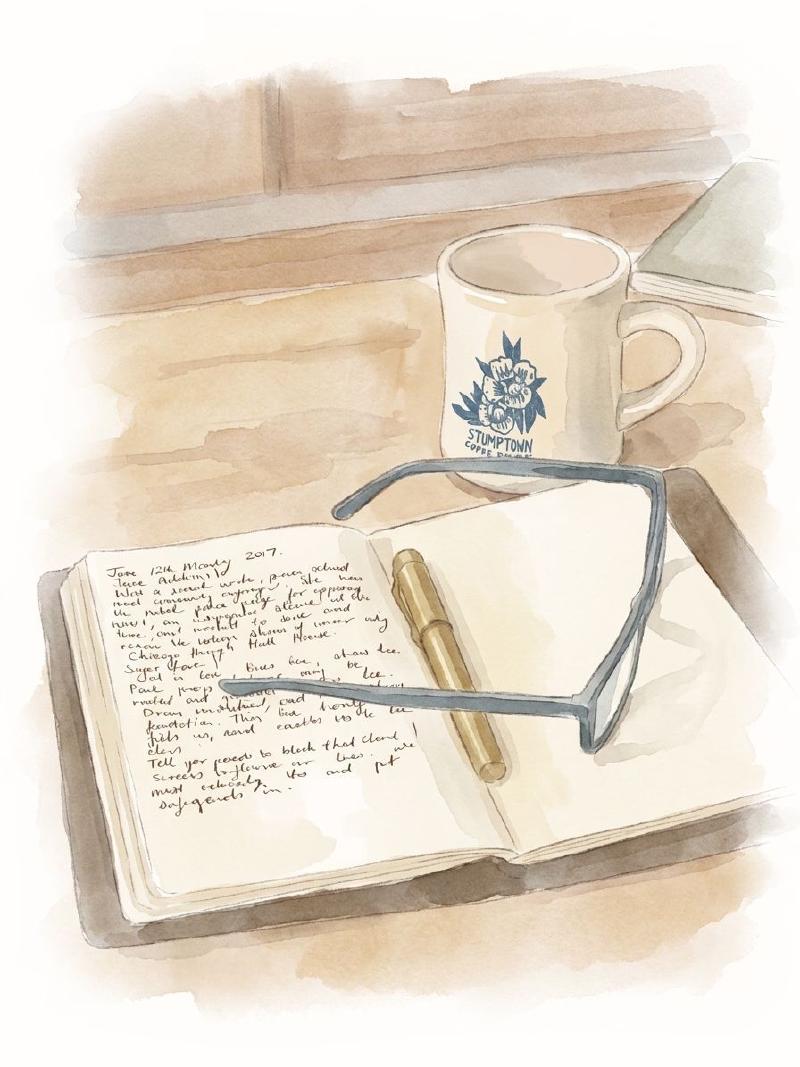
Daily reflection is powerful, but it’s not the only way to use this method. My personal favorite is actually the weekly version.
And it’s incredibly useful for people who find daily journaling too demanding.
Once a week (Sunday works beautifully for this), you sit down with your one page and do a wider-lens check-in. Like a mini weekly review, just a little gentle one.
Here’s a quick weekly structure that fits on one page:
| Section | Prompt |
|---|---|
| High Point | What was the best part of this week? |
| Challenge | What was the most challenging part, and what did I learn from it? |
| Energy Check | What energized me? And what drained me? |
| Observation | Is there anything I keep noticing week after week? |
| Next Week | What’s one thing I want to do differently or focus on? |
Each section has a purpose.
You’re not only writing. You’re processing your day in a meaningful, structured way.
And if you use a ready-made planner page and templates, this becomes even easier.
How to Set Up Your Own One-Page Journal (The Actual Structure)#
Using a one-page journal doesn’t mean you write whatever fits on one page. It has a particular structure that makes it effective.
Let’s see how you can set up your one-page journal:
Step 1: Choose a Format That Feels Easy#
Choose the format that’s easier to use, not one that’s fancy or looks perfect. And yes, know the difference between overplanning and reality.
You need something that’s accessible. This could be:
- A simple notebook
- A notes app on the phone
- A structured printed page
If your setup feels too “precious” or complicated, you will hesitate to use it.
“The easier it is to open and write, the more likely you’re to stick to that.”
That’s why a lot of people prefer pre-designed planner pages. They remove the effort of setting up over and over, every day.
Step 2: Decide When You’ll Journal#
Timing can make or break your habit.
But instead of forcing a strict routine, think about your natural flow.
Morning bullet journaling keeps your mind clear, while night journaling helps you process your day well.
There’s no “right” choice here.
The ideal time is the one you can realistically adhere to.
Anchor journaling to something you do already, like your bedtime or morning coffee routine. That way, it becomes automatic rather than something you struggle hard to remember.
Step 3: Start With Just 5 Minutes Only#
That might sound too easy-peasy and ineffective.
But it works. Yes, really.
Don’t tell yourself:
“I’m going to journal every single day.”
Tell yourself:
“I’ll only write for 5 minutes.”
That small commitment removes resistance.
And most of the time?
- You will end up writing more anyway.
- But even if you don’t, you still showed up.
With time, you will be able to build a habit that way.
Step 4: Follow a Structure So You’re Never Stuck#
Most journaling habits fall apart when you lack structure.
Because if you don’t have a proper structure in mind, you’re forced to think every time you sit down.
And thinking leads to friction.
On the other hand, if you follow a clear structure, it removes uncertainty.
You don’t waste time wondering what to write.
All you do is follow the flow:
- Thoughts
- Highlights
- Feelings
- Lessons
- Focus
Eventually, it becomes a rhythm and helps you stay on track.
Step 5: Let Go of Perfection Completely#
Last but not least, you must let go of perfection here.
Keep in mind that your journal is not:
- A place to sound “deep”
- A diary for others to read
- Or something that needs to look flawless
It’s for you, and only YOU.
Some days, your entries will feel more meaningful.
Other days, they may feel messy or random.
And that’s OKAY.
Both are valid, as the goal is not to be perfect.
It’s how well-aware you are of your own self and what works best for your unique work-life routine.
Common Mistakes That Kill Journaling Habits (And How to Avoid Them)#

Now that you’re familiar with how to set up and try one-page journaling, let’s talk about the traps. Because knowing what to avoid is literally half the battle.
So, here we go:
Mistake #1: Waiting Until You’re “In the Mood”#
If you journal only when inspiration hits and leave it when you’re not in the mood, you’re doing it wrong. Because at this rate, you will probably journal 3 times a year.
How To Avoid It:
- Pair your journal session with something you do regularly (your lunch break, morning coffee, or your wind-down before bed).
- Anchor it to an already existing habit, and make it automatic.
Mistake #2: Making It Too Complicated#
Elaborate structures, fancy prompts, and color-coded tables… These all make journaling feel more like complicated homework.
How To Avoid It:
- Keep things simple and straightforward, especially in the beginning.
- Resist your urge to overcomplicate it to perform well, because it won’t work.
Mistake #3: Treating Every Entry Like It Has to Be Profound#
Some days, your daily or weekly reflection will surely feel boring, and it’s kinda normal. “Today was fine. Work was just okay. I’m feeling tired.” All of it is valid, so don’t panic.
How To Avoid It:
- Remember that not every entry needs to be a major success.
- Ordinary tasks matter just as much (often more) as they’re a part of your real daily life, so don’t only focus on the same performance everywhere.
Mistake #4: Journaling in Isolation#
Self-reflection journals aren’t very effective alone. But unfortunately, some people don’t realize that and keep journaling in isolation.
How To Avoid It:
- Pair it with other planning tools to take it to the next level.
- If possible, consider a nice weekly planner layout side-by-side to reflect and plan in an efficient manner.
Final Thoughts#
If I had to sum this up, all honestly?
The one-page journal works because it totally respects your energy, your time, and your reality.
On top of that, it is designed for real life. For tired evenings and busy weeks and days when you have exactly 7 minutes before the next thing begins.
It gives you just enough structure to reflect meaningfully, meets you where you are, and stays convenient enough to maintain.
And the best part? It won’t demand that you be a different person.
If you’re eager to start but don’t know how, our collection of templates and self-reflection tools can truly help you in this journey.
So why still confused? Go and explore the possibilities, and pick the one that works for your needs!
Feature photo by Kelly Sikkema on Unsplash